
Tips
A Slower Summer Homeschool: Less Busy, More Meaningful
July 14, 2026
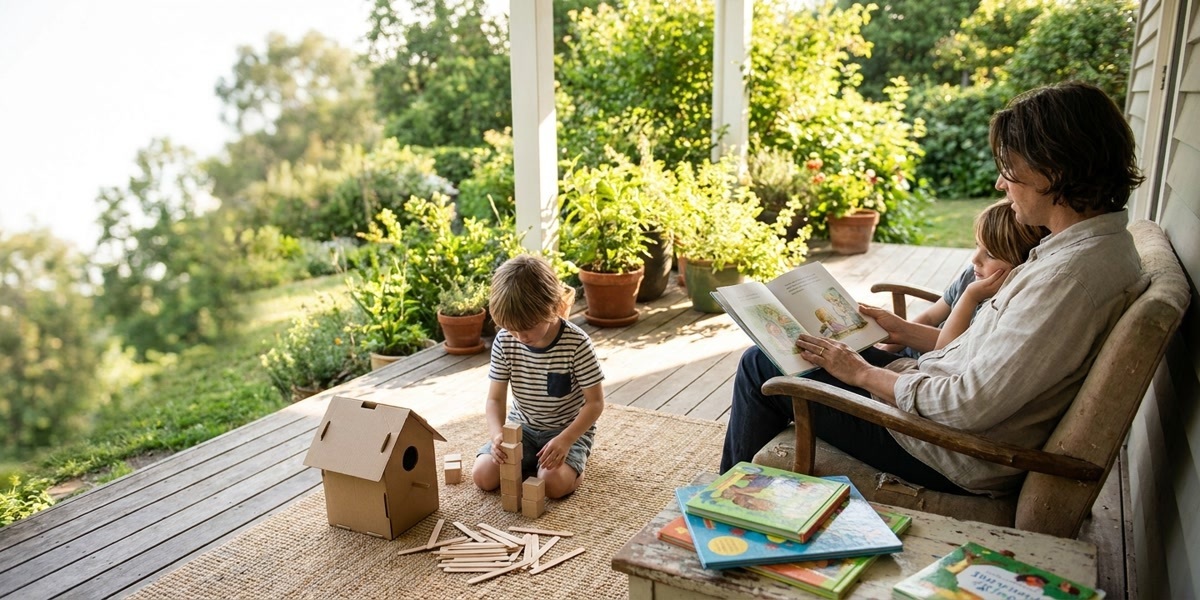
A slower homeschool summer isn’t an empty one. It’s choosing the two or three things that matter, leaving white space for play and boredom, and letting reading, writing, and building feel like life again — not school.
Every June starts the same way. We spend the school year promising ourselves a slower summer, and then the calendar fills itself before the last workbook is closed.
Camps, lessons, trips, appointments, pool days, playdates, errands, and all the projects we said we would “finally get to” once school was done.
By July, summer can start to feel just as rushed as the school year, only with more sunscreen.
It does not have to run that way.
In Slow Productivity, Cal Newport summarizes his approach this way: “Do fewer things. Work at a natural pace. Obsess over quality.” He is writing about knowledge work, but that idea feels surprisingly useful for family life, too.
A slower homeschool summer does not mean doing nothing. It does not mean letting the days dissolve into screens, snacks, and chaos. It means choosing fewer things on purpose, doing the important things well, and leaving enough space for joy to actually show up.
Matthew Kelly’s book title, Slowing Down to the Speed of Joy, gives us another helpful image. Some kinds of joy are hard to notice when everyone is rushing from one thing to the next. We have to slow down enough to see them.
So as summer begins, maybe the opportunity is not to create the perfect plan. Maybe it is to build a rhythm that is less busy and more meaningful.
Slow does not mean lazy
A lot of us accidentally measure a good homeschool day by how much we got through.
How many pages did we finish? How many activities did we attend? How many boxes did we check? How many errands did we squeeze in before dinner?
There is nothing wrong with being productive. Kids need habits. Homes need order. Meals still have to be made, laundry still has to happen, and some children really do better with a little structure.
But busyness can trick us. It can make a homeschool look full while leaving family life feeling thin.
A slow summer still has purpose. It just refuses to measure success by constant motion.
Instead of asking, “How much can we fit in?” we can ask better questions:
- What do we actually want our kids to remember from this summer?
- What habits would make our home feel more peaceful?
- What kind of learning feels natural in this season?
- What are we doing out of intention, and what are we doing because we feel pressure to keep up?
Those questions help us move from reacting to the calendar to choosing a pace on purpose.
Do fewer things, but do the important things well
If we bring Newport’s “do fewer things” idea into the home, summer starts to look different.
We do not need a full curriculum, five camps, three sports, daily worksheets, and a color-coded schedule to have a meaningful summer. For many families, two or three anchors may be enough.
A morning reading basket.
A weekly project.
Daily outside time.
A simple hospitality rhythm.
A family read-aloud.
A few chores that help kids feel like part of the household, not just guests in it.
The point is not to copy someone else’s version of a productive summer. The point is to choose what matters most in your home right now.
Maybe this is the summer your family reads through a series together. Maybe it is the summer your kids learn to cook breakfast, help in the garden, write postcards to grandparents, build forts, or spend hours outside with the neighbors.
Those things may not look impressive on a checklist. But they can become the memories and habits that make a summer feel full in the best way.
Bring back unstructured childhood
A lot of today’s parents grew up with a very different kind of summer.
No smartphones. No tablets. No endless scroll of short videos. Fewer organized activities. More bikes in driveways, kids knocking on doors, sprinklers in the yard, classic movies at night, and long afternoons where boredom eventually turned into imagination.
We do not need to pretend every part of the past was better. But there are pieces worth bringing back.
Kids need time to be outside long enough that they stop asking what to do. They need the chance to invent games, make up stories, build messy things, get hot, get tired, come in for water, and go back out again.
They need to be included in ordinary life, too. Cooking dinner. Setting the table. Helping with younger siblings. Running errands. Planting herbs. Washing fruit. Making lemonade. Cleaning up after guests.
Sometimes we think childhood memories require big trips or expensive experiences. But many of the memories that stay with us are much simpler: the smell of something baking, the sound of friends in the backyard, a movie night on the couch, or the freedom of an afternoon that was not scheduled down to the minute.
Unstructured time can feel uncomfortable at first. If everyone is used to being entertained, scheduled, or rushed, an empty afternoon may sound like a problem to solve. But white space is often where the best parts of childhood begin.
It is where a pile of cardboard becomes a rocket ship.
It is where a child picks up a book because nothing else is happening.
It is where siblings have enough time to fight, work it out, and become friends again.
It is where a casual dinner turns into a long conversation with neighbors.
White space is not wasted space. It is space left open for imagination, connection, and joy.
Make learning feel like life again
One of the best parts of homeschooling is that learning does not have to stay in a school-shaped box.
Summer is a perfect time to remember that.
A slower summer can still be a rich learning season. It just may look more like real life than formal school.
Read: Go to the library. Keep a basket of books where kids can reach them. Listen to audiobooks in the car. Read under a tree. Let older kids disappear into a series for hours.
Write: Send postcards. Keep a summer journal. Copy a favorite quote. Write a recipe. Make a packing list. Label a nature collection. Write a letter to a cousin or grandparent.
Build: Cook. Garden. Sew. Paint. Make forts. Try a backyard experiment. Help with a real household project. Create an obstacle course. Make something useful or beautiful with your hands.
This is the heart of ReadWriteBuild: reading, writing, and building are not just “school subjects.” They are ways children interact with the world.
When summer slows down, kids have more space to notice, ask, imagine, and make. That is not falling behind. That is learning in a different rhythm.
A simple slower-summer rhythm
A slower summer does not need a strict schedule. In fact, too much scheduling can defeat the purpose.
But a gentle rhythm can help the days feel peaceful instead of aimless.
Something like:
- Morning: breakfast, chores, reading or read-aloud time, then outside before it gets too hot.
- Midday: errands, cooking, pool time, a simple project, or meeting up with friends.
- Afternoon: quiet rest, independent reading, creative play, or time to build and make.
- Evening: family dinner, a walk, games, an old favorite movie, or inviting friends and neighbors over.
Every family’s season will look different. Babies, work schedules, travel, weather, ages, and energy all matter.
The goal is to choose a pace that helps your family live with more intention.
Slow enough to remember it
When the summer is over, what do we hope our kids remember?
Probably not a perfect schedule. Probably not a packed calendar. Probably not how many activities we managed to squeeze into twelve weeks.
Maybe we hope they remember that summer felt spacious.
That there were books around.
That they played outside until they were sweaty and tired.
That they helped make meals.
That friends came over.
That they made things.
That they had enough room to be bored, and then enough room to become creative.
The goal is not a perfectly productive summer. It is a summer with room for joy, growth, work, rest, and family.
Less busy. More meaningful.