
Family
A Peaceful Elementary Homeschool Day: A Read, Write, Build Sample Schedule
August 13, 2026
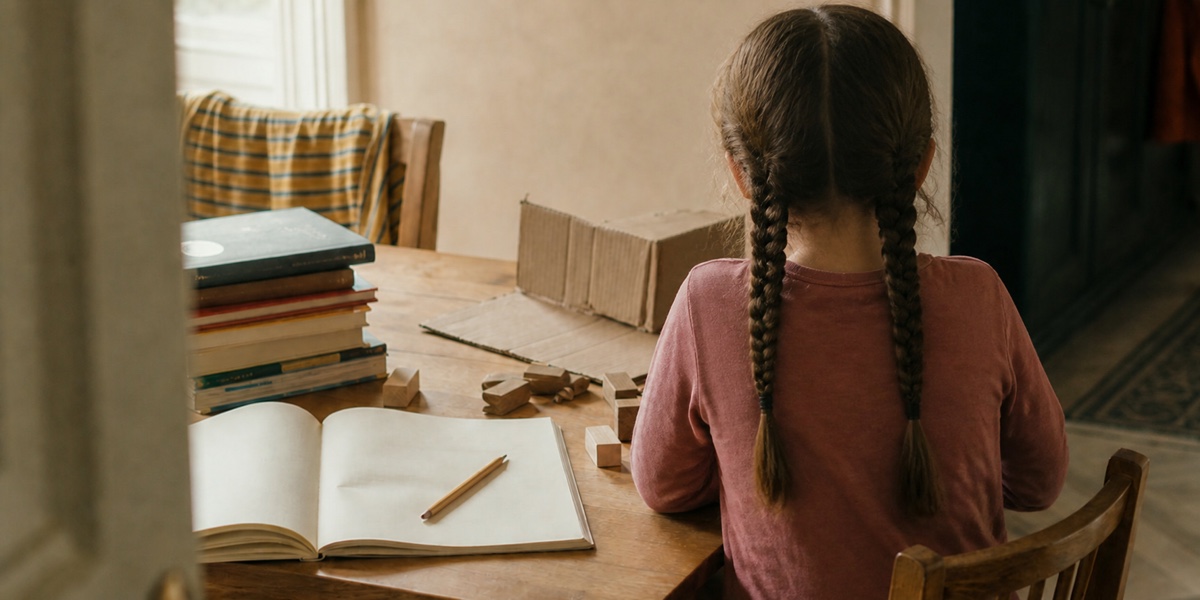
Reading, writing, and building don’t have to be three more subjects. Here’s one peaceful elementary homeschool day where they simply fit—plus a schedule you can make your own.
At 8:40, Anna is still finishing her toast when her mom opens the family read-aloud. Her little brother is coloring beside them, the breakfast dishes aren’t quite done, and nobody’s sitting at a desk.
The homeschool day has already begun.
By lunchtime, Anna will have listened to a chapter, worked through her math, copied one good sentence, told her mom two things she remembered from yesterday’s history, sketched a bird’s beak in science, and helped make lunch. Later, she’ll read on her own and go back to a cardboard marble run that’s still very much a work in progress.
None of it is elaborate. Reading, writing, and building just keep showing up, in different forms, as the day goes on.
Anna isn’t a real child—she’s a fictional composite we created to show one realistic way an elementary homeschool day can flow. She is eight years old and working at about a third-grade level. Treat her schedule as a starting point, not a rule.
The rhythm at a glance
- Age: 8
- Focused lesson window: About 8:40 a.m. to 11:30 a.m.
- Parent involvement: Close support for new lessons and transitions, with short independent stretches
- Daily anchors: Read-aloud, short lessons, outside break, quiet reading, and project time
- Prep needed: A current read-aloud, math materials, a notebook and pencil, and an easy-to-reach project basket
Reading, writing, and building aren’t three extra subjects
Read, Write, Build can sound like three more boxes to add to an already full homeschool plan. It isn’t.
For an elementary child, reading may happen during a family read-aloud, science, or quiet time. Writing may be one line of copywork, a short narration, a label, or a note to Grandma. Building may look like cooking, drawing, working a puzzle, planting herbs, or taping cardboard together on the floor.
We’re not trying to turn every moment into a lesson. The categories help us notice what’s already happening and give children a few useful choices.
Morning: begin together, then keep lessons short
Anna starts with a chapter from the family’s current novel. Beginning together gives everyone an easy entry into the morning, even when breakfast runs late.
Then comes math. Her mom teaches the new idea, stays for the first few problems, and steps away while Anna finishes the familiar work.
Next, Anna copies one strong sentence and tells her mom two things she remembers from yesterday’s history reading. Some days her mom writes down the narration. Today, Anna writes one thought herself.
Then they stop. The outside break isn’t a reward for finishing enough school. It’s part of the rhythm, helping Anna return ready for one more shared lesson.
Midday: connect school to ordinary life
Today’s final lesson is science. Anna and her mom read a few pages from a library book about birds. Anna sketches one of the beaks they studied and labels what it helps the bird eat.
She has read, observed, drawn, and written—without a separate worksheet for every skill.
Next, she helps prepare lunch. She measures ingredients, slices a banana with a child-safe knife, and sets the table. This counts as building—not because every meal needs to become a lesson, but because she’s using her hands to make something useful for the family.
After lunch and cleanup, the formal school portion of the day is over.
Afternoon: leave room to read and make
Anna’s quiet-time basket holds books, drawing paper, and an audiobook option. She chooses a chapter book today; listening while drawing could work tomorrow.
Afterward, she returns to yesterday’s cardboard marble run. One ramp keeps collapsing. Her mom helps reinforce a corner, then leaves Anna to test the next idea.
The project is still unfinished at 2:15. The marble run will still be there tomorrow—and so will the problem she hasn’t solved yet.
The rest of the afternoon stays open for outside play, errands, a friend, or nothing in particular. Read, Write, Build gives the day shape without filling every minute.
Why this rhythm works
The exact times are examples, not deadlines. What makes the day work is the order of its anchors:
- Begin together with a book.
- Keep direct lessons short.
- Put movement between periods of focus.
- Use ordinary life for meaningful work.
- Prepare a few materials, then leave room for choice.
If the morning begins twenty minutes late, the family doesn’t need to race to catch up. They can shorten a lesson, move science to another day, or let the project wait. A peaceful rhythm isn’t one that always goes according to plan. It’s one that can bend without falling apart.
Easy substitutions
Anna’s day is only one example. Cardboard can become blocks, baking, gardening, painting, sewing, a puzzle, or a household repair. Copywork can become a card, list, or caption. Quiet reading can happen through an audiobook or beside a parent.
A co-op day may mean less work at home. A working parent can place independent reading and project time around meetings. Siblings can share the read-aloud and science lesson, then separate for math and writing.
You don’t need to copy the whole schedule. Borrow one anchor that would make your day calmer: a book at breakfast, ten minutes of copywork, an outside break, or an easy-to-reach project basket.
The goal isn’t to recreate Anna’s day. It’s to help reading, writing, and building find a natural place in yours.
The sample schedule at a glance
These times are examples, not deadlines. Shift the windows to fit your family’s natural start time, work schedule, siblings, and commitments.
8:00–8:40 — Morning rhythm
Breakfast, get dressed, and complete one simple chore.
Connection: Everyday family rhythm
Parent role: Prepare the day; finish breakfast cleanup
Breakfast, get dressed, and complete one simple chore.
Connection: Everyday family rhythm
Parent role: Prepare the day; finish breakfast cleanup
8:40–9:05 — Read
Family read-aloud and brief conversation.
Connection: Read
Parent role: Read aloud; invite, but don’t quiz, conversation
Family read-aloud and brief conversation.
Connection: Read
Parent role: Read aloud; invite, but don’t quiz, conversation
9:05–9:45 — Math
Math lesson and short independent practice.
Connection: Core lesson
Parent role: Teach the new idea; step away for familiar work
Math lesson and short independent practice.
Connection: Core lesson
Parent role: Teach the new idea; step away for familiar work
9:45–10:10 — Write
Copywork and short oral-to-written narration.
Connection: Write
Parent role: Offer a sentence; listen and help only as needed
Copywork and short oral-to-written narration.
Connection: Write
Parent role: Offer a sentence; listen and help only as needed
10:10–10:50 — Movement and margin
Snack and outside play.
Connection: Movement and margin
Parent role: Reset; tend to another child or task
Snack and outside play.
Connection: Movement and margin
Parent role: Reset; tend to another child or task
10:50–11:30 — Read + Write
Science or history reading, sketch, and labels.
Connection: Read + Write
Parent role: Read together; help choose one simple response
Science or history reading, sketch, and labels.
Connection: Read + Write
Parent role: Read together; help choose one simple response
11:30–12:30 — Build
Prepare, eat, and clean up lunch.
Connection: Build
Parent role: Give Anna one real, age-appropriate job
Prepare, eat, and clean up lunch.
Connection: Build
Parent role: Give Anna one real, age-appropriate job
12:30–1:15 — Read
Quiet time with a book or audiobook.
Connection: Read
Parent role: Protect the quiet window
Quiet time with a book or audiobook.
Connection: Read
Parent role: Protect the quiet window
1:15–2:15 — Build
Cardboard marble run or another hands-on project.
Connection: Build; optional labels or plan
Parent role: Set out materials; help at a true sticking point
Cardboard marble run or another hands-on project.
Connection: Build; optional labels or plan
Parent role: Set out materials; help at a true sticking point
After 2:15 — Open afternoon
Outside play, errands, friends, rest, or continued project time.
Connection: Child-led and flexible
Parent role: Leave margin rather than filling the afternoon
Outside play, errands, friends, rest, or continued project time.
Connection: Child-led and flexible
Parent role: Leave margin rather than filling the afternoon
Evening — Read and reconnect
Family dinner and optional bedtime reading.
Connection: Read and family connection
Parent role: Read together or let Anna read independently
Family dinner and optional bedtime reading.
Connection: Read and family connection
Parent role: Read together or let Anna read independently