
Success Stories
The Long-Term Benefits of Raising Kids Who Read, Write, and Build
July 29, 2026
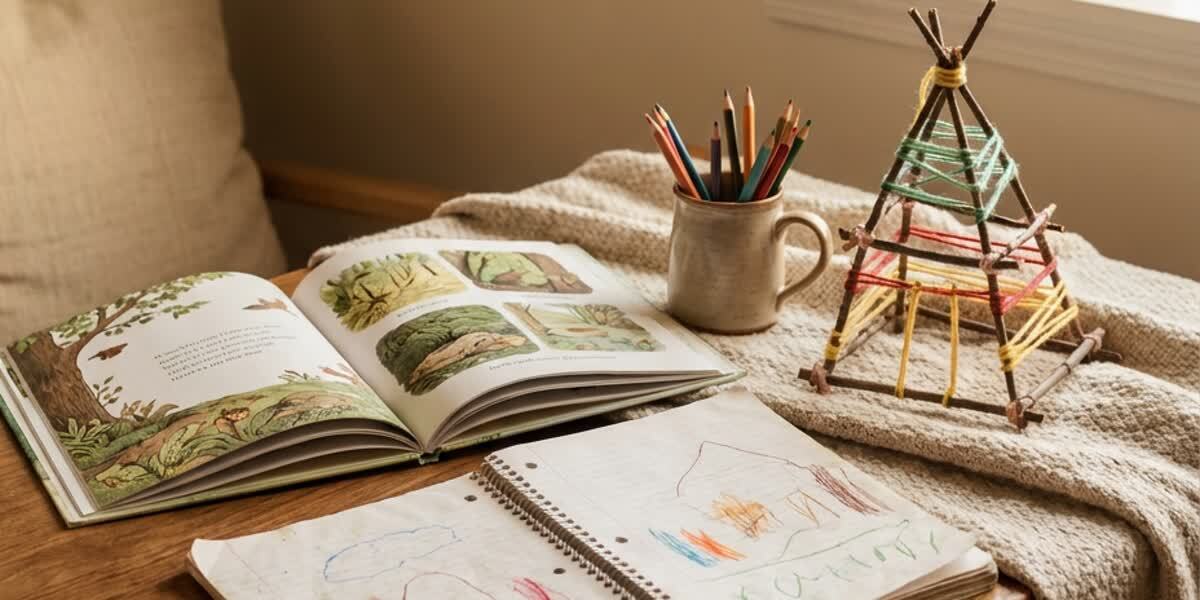
Every kid says “I'm bored.” What if the answer wasn't a screen, but three words — read, write, or build? A small family habit, and the kind of person it quietly helps a child become.
Every home has its own version of this moment.
A child wanders into the kitchen, opens the pantry, closes it, and announces there is nothing to do. Left alone, they drift toward whatever takes the least effort: a screen, a silly toy, a sibling to bother, or the nearest thing that entertains.
Adults do it too.
We get a free half hour, pick up the phone “for a minute,” and stand up an hour later more scattered than when we sat down.
None of that is the enemy. Families need downtime. Kids need play. Everyone needs low-effort moments.
But when consuming something becomes the only answer we know to an open afternoon, it stops feeling like rest.
Reading, writing, and building are different. They ask more of us, and they usually give more back. You finish a chapter, a page, or a small project and feel a little more like yourself — not because it was impressive, but because you participated in your own life instead of being entertained through it.
That is why “Read, Write, Build” is more than our name. In our house, it became a habit: a better answer to “I'm bored,” and a way to teach our kids what to do with their own time, hands, and minds.
A better default for free time
A lot of the conversation about kids and boredom focuses on the problem: kids today do not know how to be bored.
There is some truth there. Many children have grown up surrounded by instant entertainment. If there is always a show, game, tablet, phone, or short video nearby, boredom never has to become imagination.
But the answer is not to fill every minute with better activities.
Kids do not need every afternoon optimized, every hobby formalized, or every interest turned into a class. They need room to be bored, and they also need simple categories for what they can do when boredom arrives.
That is where a phrase can help:
Find something to read, write, or build.
It is clear enough for a child to understand and flexible enough to grow with them.
Read a picture book. Write a story. Build with blocks. Draw a comic. Make a card. Do a puzzle. Copy a favorite sentence. Cook something. Sew something. Build a fort. Start a notebook. Pick up a real book. Make something useful or beautiful.
The phrase does not make free time heavy. It gives free time direction.
How Read, Write, Build became a family mantra
When my children had free time, they often defaulted to frivolous toys or requests for movies and video games. I found myself trying to steer them toward something more enriching, but I did not always want to give a speech or list ten different options.
Around that time, I had heard Sarah Mackenzie talk about naming things in your homeschool on Circle with Sarah, Episode 76, “Name Things.” She encouraged homeschool moms to give a name to activities they were already doing, so that name could be used again and again. That idea stuck with me.
Eventually, I started saying: read, write, or build.
If the kids were between subjects, wandering after lunch, or looking for something to do, I would encourage them to choose something from one of those categories. It quickly became a household mantra.
The point was not that the phrase was magic. It was that it gave us a repeatable way to redirect free time without turning every moment into a lecture.
Instead of saying, “Go do something productive,” we could say: find something to read, write, or build.
For younger kids, “build” might mean Legos, Magna-Tiles, blocks, puzzles, pretend play, drawing, coloring, or making a little book out of folded paper. It does not have to look impressive. It just has to invite them to make something.
As kids grow, the same categories grow with them.
Reading can become chapter books, biographies, Scripture, history, science, poetry, essays, or a deep dive into a new interest.
Writing can become journaling, letters, stories, essays, notes, plans, scripts, recipes, lists, or a commonplace book.
Building can become cooking, gardening, woodworking, sewing, coding, music, art, experiments, business ideas, home projects, or anything that turns thought into something visible.
The categories stay steady. The expression matures.
Productive without being performative
When we talk about raising kids who read, write, and build, we are not talking about turning childhood into one long résumé.
This is not about making every moment “educational.” It is not about forcing children to produce something impressive. It is not about raising little adults who never rest, play, or waste time.
Childhood needs silliness. It needs wandering. It needs ordinary downtime.
But reading, writing, and building are productive in a deeper sense. They help a child participate.
Reading gives children ideas, language, stories, and knowledge. It lets them live beyond the limits of their own immediate experience.
Writing helps children notice what they think. A child who writes has a place to remember, imagine, explain, persuade, process, and communicate.
Building teaches agency. It shows a child that the world is not only something to watch. It is something they can shape, repair, improve, and contribute to.
Those are not just school outcomes. They show up in real life.
A child who reads is less dependent on whatever idea an algorithm puts in front of them.
A child who writes has a way to sort through what is happening inside of them.
A child who builds learns that frustration is often part of the process, not a sign that the project is over.
Creating a little more than we consume
Consumption is not the enemy.
Families can enjoy movies. Kids can play games. Everyone needs rest. Sometimes a light, easy activity is exactly what a tired body or mind needs.
The problem is when consumption becomes the main thing we know how to do.
We see this in ourselves. We sit down to scroll for a minute and stand up feeling scattered. We watch one more video and feel strangely less satisfied. We reach for entertainment because we are tired, but it does not always restore us.
Children need to experience the difference between being passively entertained and being meaningfully engaged.
They need to feel the quiet pride of finishing a book, writing a page, building a tower, making a meal, solving a problem, or creating something that did not exist before.
Those moments do not guarantee a child will become a certain kind of adult. But they do give children practice in important things: paying attention, beginning when something feels hard, trying again when the first attempt fails, and using their own minds and hands to make something happen.
Over time, that practice matters.
A child who reads often becomes more comfortable with language and ideas.
A child who writes often becomes more comfortable thinking on paper.
A child who builds often becomes more comfortable solving problems through trial and error.
Little by little, children learn that boredom is not an emergency. It can be an invitation.
When they are bored, they can pick up a book.
When they are full of ideas, they can put words on a page.
When they see a problem or possibility, they can make something.
That is a better default than waiting for the world to entertain them.
How parents can make it normal
The goal is not to make Read, Write, Build feel like another assignment.
The goal is to make it feel normal.
A few simple things help.
Keep books where kids can reach them. Put baskets in the living room, bedroom, car, or wherever your family naturally gathers.
Keep writing materials available. Paper, pencils, notebooks, index cards, envelopes, clipboards, and markers invite children to write without needing permission every time.
Keep building materials visible. Blocks, Legos, Magna-Tiles, cardboard, tape, craft supplies, wood scraps, fabric, tools, kitchen ingredients, or whatever fits your home and ages.
Use the phrase calmly. “Find something to read, write, or build” works best when it is not a punishment. It is just the family way of redirecting free time.
Let it be small. A child does not need to write a novel. They can make a card. They do not need to build a masterpiece. They can make a tower. They do not need to read for two hours. They can look through a picture book or read one chapter.
Praise the tendency, not only the finished product. Notice when they reach for a book, start a notebook, make something, try again, or use their time creatively.
And perhaps most importantly, model it.
Let your kids see you read instead of always scrolling. Let them see you write a note, a list, a letter, a plan, or a prayer. Let them see you cook, fix, plant, organize, paint, sew, build, or improve something around the house.
Children are always learning what adults do with free time.
If we want them to create more than they consume, they need to see us practicing that too.
A habit worth carrying forward
The goal is not to raise children who never relax.
The goal is not to make every hobby productive or every afternoon impressive.
The goal is to raise children whose default response to free time is not always consumption.
We want them to know the feeling of getting lost in a book. The satisfaction of putting thoughts into words. The pride of making something with their hands. The patience of trying again when a project does not work the first time.
We want them to grow up with a toolkit they can carry into any season of life.
Because boredom does not disappear when childhood ends. Neither does the pull toward easy entertainment.
But a child who has practiced reading, writing, and building has other options. They know how to learn something, express something, make something, and begin again.
That is not a small thing.
It is a family habit worth building.
If you want to learn more about how to encourage and track your child's reading, writing and building progress, check out the app here: https://readwritebuild.com/membership.
If you want to learn more about how to encourage and track your child's reading, writing and building progress, check out the app here: https://readwritebuild.com/membership.